
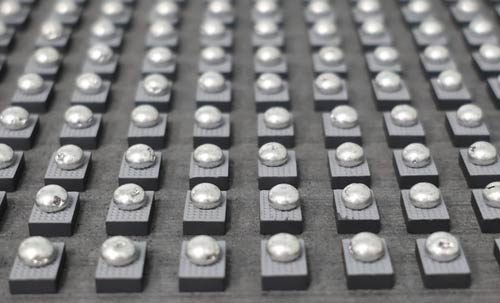
Medium voltage contacts and subassemblies are found in a wide range of demanding switching and arc-resistant applications. These components are generally out of sight, but perform crucial tasks, particularly for power distribution. Failure can lead to fires or power outages. To minimize these risks, manufacturers must pay close attention to the contact’s material quality and consistency. This is where ASTM International comes in. They set standards for material properties, testing, and other factors. In this post, we’ll look at ASTM guidelines for two contact materials, and how we helped revise them to meet today’s needs.
Required Material Properties
Medium voltage contacts face two demanding requirements: excellent conductivity and melting/deformation resistance. Silver is the ideal base material for conductivity. But silver is soft and can melt at a relatively low temperature. To solve this, manufacturers use powder metallurgy to produce contacts. This process allows them to blend silver and other materials that will enhance hardness and thermal resistance. Two of the most used material mixes are silver-molybdenum (ASTM B662-26), and silver-tungsten carbide (ASTM B663-26).
Silver Molybdenum – Molybdenum is a refractory metal with a very high melting point. This makes it ideal for uses such as high voltage circuit breakers, which handle massive energy surges during a short circuit. Silver alone could not survive this. However, molybdenum has a very high melting point to compensate for silver’s weakness. Its particles form a structural matrix that remains even if an electrical arc begins to liquefy the silver on the surface as defined in ASTM B662. As a result, the contact maintains its shape.
Silver Tungsten Carbide – is a refractory ceramic-metal composite. Tungsten has the highest melting point of all metals. In B663, it is combined with carbon and placed in a silver matrix to form Ag-WC composite. This significantly increases the materials hardness and chemical stability. In addition to extreme hardness, the material has excellent weld resistance. This prevents silver components from welding together when subject to massive arcs. Without the carbide, the arc would otherwise melt and fuse the components.
Applications
Medium voltage contacts are critical components found in power grid devices that regulate voltage and stabilize power delivery. As power demands are changing rapidly, the electrical infrastructure must keep pace. Smart grids require more sophisticated controls and load balancing than conventional power systems. Upgrading the infrastructure means contact materials such silver molybdenum and silver tungsten carbide are gaining importance.
The Revision Process
As demands for medium voltage contacts continue to evolve, so must the guidelines that govern their materials. However, the ASTM specifications for both materials hadn’t been updated for decades. Deringer Ney undertook the task and worked with ASTM to update the specifications for both materials. Changes were made to the following:
- Best practices for density measurement
- Sampling requirements
- Quality assurance
- Corrosion testing
- Specific test methods
- Updated terminology
- Style and format (for consistency)
Conclusion
Updating ASTM B662-26 and B663-26 will help manufacturers make sure they can produce quality contacts that meet the modern grid demands. As power systems become complex, having updated standards in place will help ensure equipment reliability. This will also give manufacturers and utility operators confidence that contacts will perform safely and consistently in critical power infrastructure.