
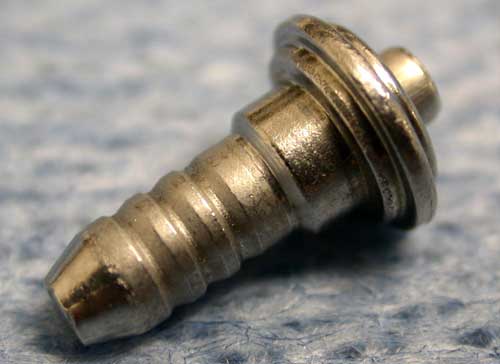
Form rolled pins, often referred to as “pins” or “headless pins”, are fasteners designed to hold, connect, and position custom electronic and mechanical assemblies. But they are more than simple metal rods. Pins are much more complex. They typically contain retention features or precise radiuses, and can be held to tight tolerances to satisfy demanding applications. In this post, we’ll look closely at form rolled pins, where they are used, how they are made, and see how form rolling compares to screw machining.
Where Are Rolled Form Pins Used?
Pin designs are flexible and allow for barbs, annular rings, knurls, and rounded ends. This makes them ideal for demanding applications that require precise retention. These include:
Electrical/Electronics – pins can be made with smooth, full-radius tips that mate with spring contacts to deliver a firm grip force without grinding. This makes them ideal for electrical terminals, circuit boards and switchboards, and connectors.
Electro-Mechanical Assemblies – form rolled pins can function as actuator pins, plungers, sliding mechanisms, and press buttons in custom electro-mechanical assemblies. Windshield wiper motors or other small drive assemblies are great examples.
Molded Enclosures and Components – pins can be integrated directly into custom plastic molded housings via automated press-fitting or insert molding. These applications rely on specialized retention features, such as annular rings and deep grooves, to permanently lock the pin in place. A great example of a molded component is a terminal pin on a fine wire winding.
How Are Form Rolled Pins Made?
While the process will change depending on the specifications of the job, here’s the general production sequence:
- Material Selection – Start by selecting wire that is engineered to the proper temper. Many materials or alloys can be used. Selection is based on required corrosion resistance, strength, and other factors. (We’ll get more into materials in a bit.)
- Straightening & Cutting – the wire is fed into a pin roller, which straightens and precisely cuts it into blanks.
- Forming & Rolling – The dies will cold-form the wire, rolling the specialized features into the blanks. These commonly include radiuses, chamfers, barbs, or retention knurls.
Materials
As with any fabricated component, pin material selection is driven by the needs of the end use and its environment. While this can change dramatically, one common material consideration is ductility, since cold forming requires metals that will flow without cracking.
Pin materials fit loosely into the following categories:
Precious Metals & Alloys – include Gold, Palladium, Paliney 6 & 7, Neyoro, and Platinum-Iridium. A great application example would be the use of gold for radiopaque medical pin-markers that need to show up under X-ray.
Copper and Brass – Cartridge Brass (70/30), Pure Copper (C110), and Oxygen-Free High-Conductivity Copper (C102) are used in high-performance electrical contacts that require both excellent conductivity as well as corrosion resistance.
Phosphor Bronze – offers high fatigue resistance, spring-like elasticity, excellent wear resistance, and good electrical conductivity. This makes it ideal for any part that moves, flexes and carries current. Examples include relay switch plungers, tactile push-buttons, or marine-grade electrical connectors and housings.
Low-Carbon Steels – steels such as 1008 and 1018 offer high structural strength, excellent cold-formability (ductility), and cost efficiency. Low-carbon steels rust easily, so they’re limited to structural, mechanical, and grounded applications. Even for these uses, steel should be plated for corrosion resistance. Examples include power tool housings, automotive door-latch assemblies, and terminal blocks.
Form Rolling vs Screw Machining
While form rolling is often the method of choice for manufacturing pins, screw machining may also be used. The biggest advantage of screw machining is that it can achieve slightly tighter length tolerances. Otherwise, form rolling offers many benefits:
- Superior speed, efficiency and cost savings for high-volume pin production.
- Lower scrap rates – form rolling cold-shapes wire rather than cutting away metal, as done in screw machining. This is particularly beneficial if precious metals or alloys are being used.
- Efficient Feature Production – with form rolling, features such as knurls, barbs, and annular rings are formed directly in a single pass. Conversely, screw machining requires secondaries to get these done. These typically add cost and extend delivery time.
Conclusion
Regardless of the assembly or product’s use, selecting the right fastener is crucial for long-term reliability and performance. Form rolled pins deliver the ideal combination of precise geometry, material efficiency and high retention strength required for countless applications. By replacing machining with cold-forming technology, manufacturers can achieve excellent component performance while lowering production costs and shortening delivery lead times.