
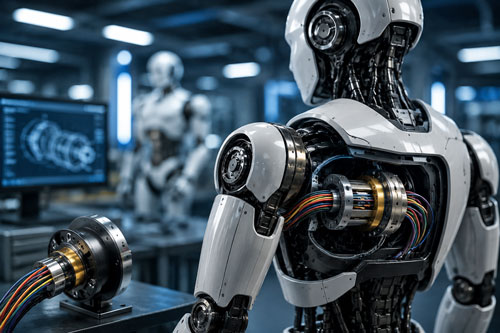
You’ve likely seen them on social media, on TV, or elsewhere. Suddenly, humanoid robots are showing up everywhere. Annual sales of humanoid robots are projected to reach roughly $300 billion by 2035, up from around $2 billion in 2025 (J.P. Morgan Private Bank). A mere decade ago, these robots were little more than science fiction. But today, they are already serving many roles. Picking parts in a warehouse. Welding on assembly lines. Serving food in restaurants. They are even taking on more dangerous tasks such as firefighting and electrical work.
The Flexibility Challenge
Ironically, the feature that makes humanoid robots so useful is the same one that has historically made them a challenge to design and build. They have joints that move the same way ours do. Their waists twist, wrists spin and necks turn. However, for a robot to function effectively in the real world, these movable features need to rotate continuously. But conventional wire-based connectivity can’t handle this task. While standard cables can flex, they can’t be wound around the same axis repeatedly. They will twist, kink, and eventually fail. This is where slip rings come in.
Keeping the Connection
Slip rings are rotary connectors that maintain a continuous connection between a stationary and rotating component. This allows a reliable connection at each joint, without cables that can twist and tangle. No matter how many times they rotate, the connections stay intact.
Modern slip rings can carry more than just power. They can pass Ethernet, USB, CAN bus, RS-485, HDMI, and even fiber-optic signals through the rotating joints as well. This is an important feature, as the limbs and heads of humanoid robots are packed with motors, sensors, cameras, encoders, and onboard AI. All these components need both reliable power and high-speed, often bidirectional, data flow.
Slip rings are found throughout a robot:
Neck – for head rotation with cameras and sensors
Waist & Torso – allowing the upper body to rotate independently of the lower body
Shoulders, Wrists, and Forearms – to give hands full dexterity
Though not every joint requires a slip ring. For those that only need to rotate to a defined limit, such as 180°, conventional cable loops or careful cable routing will get the job done. Elbows and knees are good examples, since they just need to flex back and forth rather than rotate continuously.
Overcoming Engineering Challenges
While slip rings are powerful devices, they do come with a few drawbacks. They typically add to weight and cost when compared to alternative approaches. They can also present a few engineering challenges. Contact resistance is one. This is the electrical resistance at the interface where the rotating and stationary parts touch. The problem is that since parts are moving, there isn’t a solid, fixed connection. It’s a moving mechanical interface, which can cause issues with voltage consistency. While negligible fluctuation can usually be tolerated, if a slip ring is carrying high current, it could add up to power loss and intense heating at the joint. This can be an even bigger issue for high-speed data transmission, since fluctuations can introduce noise or signal degradation. To mitigate this issue, more advanced slip rings will separate power and data into different contact rings and materials. Alternatively, data transmission can happen across fiber-optic joints to avoid this entirely.
Next-Generation Slip Ring Alloys
Deringer Ney has developed newer alloys to address these contact resistance and current-carrying challenges. Specifically, Paliney 25 and Paliney 35, which offer higher electrical conductivity than the long-standing industry standard, Paliney 7. The newer alloys enable higher current capacity and better thermal stability without sacrificing corrosion resistance and mechanical reliability. This makes them well-suited for compact, high-cycle joints found in humanoid robots, where both power and data need to move reliably through a small rotating interface over many cycles.
Alternatives
There are some alternatives to slip rings, particularly for joints that don’t need to rotate indefinitely. These include flex cable loops, shaft routing and even wireless configurations. But for joints that need to turn at 360°, slip rings are the technology that makes it happen.
Conclusion
As humanoid robots continue to move from demo videos into the real world, the engineering behind them will matter as much as the logic and AI that drive them. Slip rings are a core part of what allows robots to have reliable and consistent human-like movements. As the market and demands continue to quickly grow, it’s not just the humanoids with the smartest AI that will succeed. It’s the ones with dependable slip rings that will reliably perform countless functions over millions of cycles.