
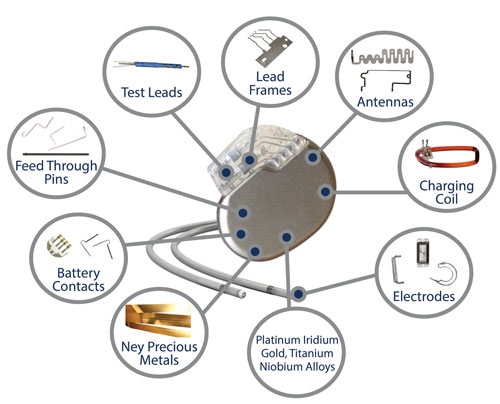
We talk a lot about demanding applications for electrical contacts and components. But when it comes to unwelcome environments, there’s one that’s often more challenging than the rest: the human body. This creates a unique set of hurdles for implantable medical devices. Their electrodes must function reliably for years or decades inside this corrosive, living environment. Today, we’ll look closely at the demands of medical implants and how they can be met.
Technological advancements over the last 75 years have allowed for incredible breakthroughs in medical treatments such as medical implants. These include cochlear implants, nervous system stimulators, and other implantable electrode systems. They are used to treat a wide range of issues including epilepsy, depression, chronic pain, paralysis and so much more.
The Unique Demands of the Application
The body’s environment is warm, salty and oxygen rich. Not ideal for most metals, as it’s a perfect recipe for corrosion and other threats. To reliably perform their intended function, electrodes must be able to resist corrosion. They also must not release ions or particles that could damage cells or organs.
This concept is known as biocompatibility. Getting it right means that the device can faithfully perform its function within living tissue, without causing harmful biological responses. Getting it wrong can lead to inflammation, allergic responses, toxicity, and other undesired results.
Besides physical durability, another key success factor for therapy implant electrodes is charge storage capacity (CSC). This represents how much electrical charge the material can store and deliver. Using a material with a higher CSC may mean the device can deliver stronger or longer electrical pulses. But the material must be able to inject a charge safely, without degrading or producing toxic byproducts that could harm surrounding tissue.
Biocompatible Electrode Metals
Raw electrode metals usually include copper, iridium, palladium, platinum, titanium, and occasionally gold. These are often alloyed to change or enhance the base material’s properties. Interestingly, few studies have been available that compare different electrodes made from various metals in biologically relevant media. As producers of precious metal alloys for medical applications, we took the opportunity to better understand how our materials stood up to the challenges. (Spoiler alert: what we learned surprised us!) But let’s quickly review what we did before we get into the results.
In our study, we compared platinum, palladium, and gold-based electrodes’ potentiometric scans and their corresponding charge storage capacities. We tested ten different metals and alloys in total. CSC values were calculated for the oxide reduction, hydrogen adsorption, hydrogen desorption, and oxide formation peaks.
If you’d like to learn more about the testing and results, check out our White Paper here.
The Winners
Two materials outperformed the rest. One was platinum. This did not surprise us. Platinum’s properties – specifically its biocompatibility, corrosion resistance, and electrochemical properties are a solid match for the challenges of the human body. The other top performer was our Paliney 1100, which is an alloy of palladium and rhenium. Paliney 1100 gave the highest observed total CSC value. We were pleasantly surprised to learn that palladium-based alloys outperformed platinum-based alloys, specifically in the sparged condition and were ranked equally as high in the aerated condition.
So, what does this all mean? It comes down to having more material candidates for certain medical electrode and other demanding applications. We now know that Paliney 1100 can be a suitable alternative to platinum iridium in certain electrode applications. The palladium provides good biocompatibility with excellent corrosion resistance, while the rhenium supplies high strength and durability. Also, palladium alloys are generally less expensive than platinum. But of course, this depends on the volatile precious metals market.
Conclusion
Paliney can’t be a substitute 100% of the time. There will always be differences in properties when compared to similar materials. For instance, palladium’s ability to absorb hydrogen and lower reversibility may present barriers to application. As always, you must make sure that the material properties meet the performance demands of the specific application and operating environment. But the results of our comprehensive study do conclude that palladium-based alloys, specifically Paliney 1100, can certainly be considered for implantable electrodes.